


 Fr
Fr
On a corporate balance sheet, a traditional 10-year commercial lease used to look like stability. Today, it looks like a liability.
With macroeconomic indicators fluctuating globally and generative AI fundamentally reshaping team headcount requirements overnight, the rigid real estate commitments of the past are becoming a massive operational drag.
We sat down with Sanne van Wunsel, Strategic Partner at Sequel, at Workways Brussels Airport to unpack a concept that traditional landlords ignore: the true cost of inflexibility. Here is why forward-thinking leaders are moving away from traditional square footage and shifting toward the “Space-as-a-Service” model to secure capital, protect margins, and future-proof their operations.
1. The Cost of Inflexibility vs. Flexibility
When evaluating corporate real estate, a CFO’s first instinct is often to look at the raw cost per square meter over a decade. On paper, a long-term traditional lease can appear cost-effective. But that calculation assumes the world stands still.
“CFOs need to consider the cost of inflexibility versus flexibility,” Sanne van Wunsel explains. “A 10-year lease might look better on paper cost-wise sometimes, but what do you actually get for it? You get a fixed amount of space that cannot easily be altered to growing needs. How can you look 10 years into the future? You simply don’t know what’s coming ahead.”
In a volatile market, the ability to scale back or expand instantly isn’t just an operational perk—it’s a risk-mitigation strategy.
2. Weathering the Macroeconomic and AI Shifts
Two massive forces are currently disrupting team headcount projections: macroeconomic instability and technological efficiency. If a business adopts advanced AI workflows that automate manual processes, a team that once required 50 desks might only need 30 next year. Conversely, a rapid market breakthrough might require scaling from 10 to 40 people in a single quarter.
“We’ve seen the macroeconomics all over the place lately,” notes Sanne. “A lot of things are happening, whether it’s due to an economic downturn or efficiency driven by AI. Taking into account the hidden opportunity costs of being locked down is a vital factor most financial models miss.”
By shifting commercial real estate from a rigid Capital Expenditure (CapEx) to an agile Operational Expenditure (OpEx), CFOs protect the balance sheet from paying for empty, unutilized space.
3. Real-Time Proof of Concept: Upgrading on Demand
The power of the Workways model isn’t theoretical; it’s happening in real time. Sequel practices exactly what they preach. Having entered Workways Brussels Airport as one of the very first tenants, Sanne’s team hit a growth surge this month.
“We actually started in a smaller office, and we are upgrading just now because our team is expanding. It offers exactly that flexibility. It takes away the friction that regular spaces provide.”
Under a traditional lease, an expansion like this triggers complex negotiations, secondary legal fees, or a forced premature relocation. At Workways, it’s handled with a simple adjustment to the monthly agreement, keeping the team focused on revenue, not real estate logistics.
4. Reclaiming the Collaboration Dividend
While remote work has been used by finance teams to cut immediate real estate costs, it has introduced a hidden tax on creativity and team alignment. The modern CFO is realizing that total isolation damages long-term productivity.
“Working from home can be beneficial, but it’s also really isolating,” Sanne highlights. “You miss the brainstorming with your colleagues to move forward. I’m a big believer in combining different minds to create an open mind to move ahead. When you meet in person, it is a lot more efficient and a lot more creativity comes up.”
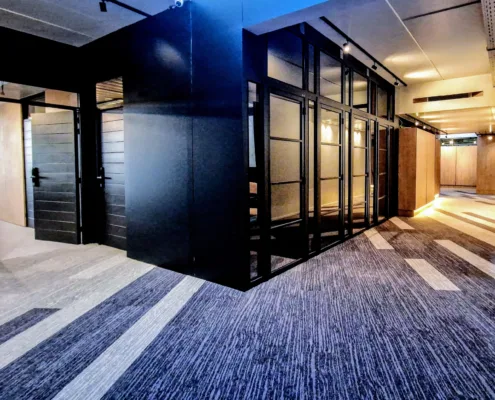
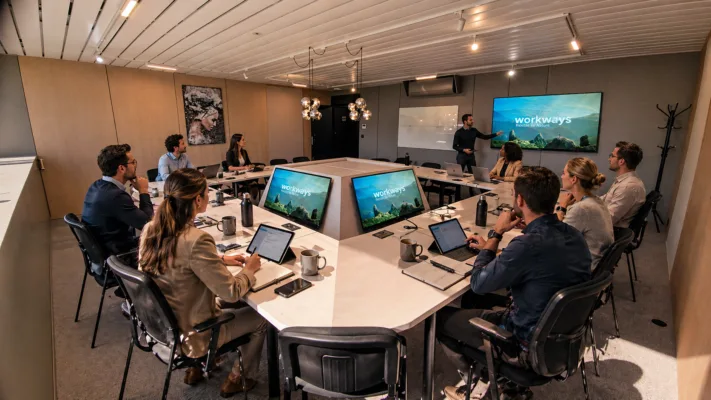
The solution isn’t forcing people back into rigid cubicles. It’s providing a destination—a premium environment with an on-site gym, an enterprise-grade kitchen, and professional meeting rooms that command respect when receiving high-level clients.
The Financial Verdict
Traditional real estate forces a CFO to bet on an unpredictable 10-year forecast. Workways allows a company to buy only the space they need for the headcount they have today, with the absolute freedom to change their mind tomorrow.
With premium, new-build private suites at Building 44 starting at an accessible €499/month and a transparent additional person scaling model, you can provide your team with enterprise-grade infrastructure without exposing your capital to long-term risk.
Ready to eliminate the Inflexibility Tax from your balance sheet?