


 Fr
Fr
It is Q2 2026. You have just closed the books on the first quarter, and you are staring down your real estate budget.
If you read the mainstream financial headlines right now, you might feel a false sense of security. The media is loudly declaring that the European office market is fully recovering. They are pointing to massive take-up spikes—like Dublin surging by 40% and Frankfurt by 45%—as proof that the traditional office is back and healthier than ever.
However, those headlines are hiding a dangerous truth.
We are not experiencing a market-wide recovery. Instead, we are living through a violent, structural “K-Shaped” fracture. The market is violently splitting in two directions. A tiny fraction of premium workspaces is skyrocketing in value, while the vast majority of older buildings are quietly collapsing into obsolescence.
If you sign a traditional lease today without understanding this K-shaped fracture, you are not just locking your company into a bad financial deal. You are tying your business to a sinking ship.
Welcome to the era of stranded office assets.
The Illusion of the “Cheap” Traditional Lease
Let’s talk about the bottom of the “K.”
Right now, landlords of secondary, older office buildings are getting desperate. They are offering heavy discounts, long rent-free periods, and seemingly attractive 5-year to 10-year lease terms. To a CFO looking to trim OpEx in 2026, these deals look incredibly tempting.
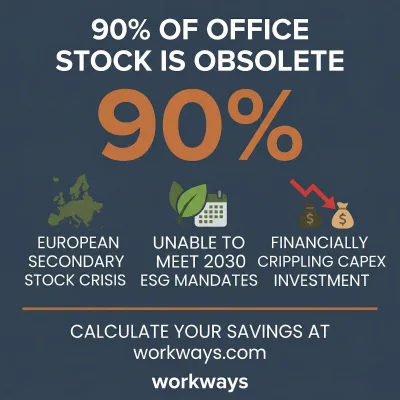 But this is the ultimate trap. These buildings are not cheap; they are obsolete.
According to recent data synthesised from leading property analysts like Principal Real Estate Europe, lower-quality properties are officially at risk of becoming “stranded office assets.” A stranded asset is a property that is no longer economically viable to upgrade or maintain.
Think about the physical reality of a 1990s or 2000s concrete office block. The ceilings are too low for modern, energy-efficient HVAC systems. Furthermore, the electrical grids cannot handle the gigawatt demands of localised AI servers. Most importantly, they leak energy like a sieve.
When you sign a lease in one of these buildings, you are taking on the landlord’s problem. You will suffer through failing infrastructure, terrible employee retention, and a workspace that actively hurts your corporate ESG reporting.
 The ESG Financing Wall
If you think the landlord will eventually fix the building, think again. They simply cannot afford to.
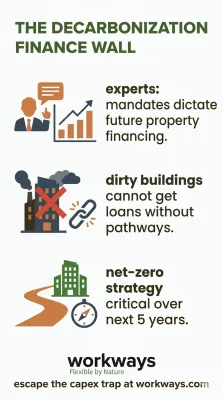
We have officially hit the ESG financing wall. Banks and institutional lenders are aggressively pulling back capital from “dirty” real estate.
According to PwC’s Emerging Trends in Real Estate reports, nearly 90% of industry experts expect CapEx requirements for net-zero transitions to entirely dictate real estate financing over the next five years.
Therefore, property owners without a clear, massively expensive net-zero pathway are actively struggling to get loans. They cannot secure the capital needed to retrofit their buildings. Consequently, these stranded office assets will sit and slowly decay, eventually being sold off to be demolished or converted into residential housing.
As a corporate tenant, you do not want your team trapped inside a decaying asset during a five-year lease term.
The Squeeze at the Top of the Market
So, if the bottom of the market is full of stranded office assets, the logical solution is to move to the top of the “K.” You want the Grade-A, ESG-compliant, BREEAM-certified, smart-sensor-enabled premium buildings.
This is where the second half of the trap snaps shut.
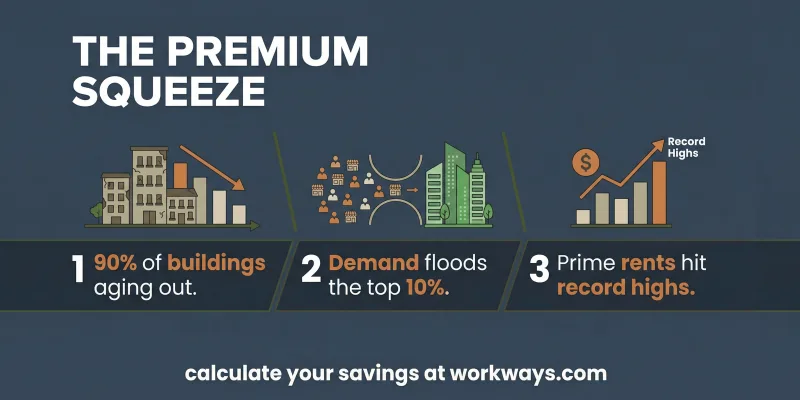
Everyone else is trying to do the exact same thing. Altus Group’s valuation reports confirm a severe “flight-to-quality,” noting an extreme bifurcation between “the best and the rest.” The demand for premium space in cities like Paris, Dublin, and Brussels is hyper-concentrated.
Because nobody has been funding new construction over the last few years, the supply of these premium buildings is incredibly choked. Savills recently highlighted that this shortage of prime new developments is leaving occupiers with very few options at lease expiry.
When demand is massive and supply is choked, landlords hold all the cards. Prime traditional rents are surging. Landlords of top-tier buildings are demanding massive guarantees, higher base rents, and rigid terms.
As a business leader, you are stuck between a rock and a hard place. You can either sign a cheap lease in a dying building, or you can bleed your balance sheet dry paying exorbitant traditional rents for a premium space.
The Fractional Escape Route: Space-as-a-Service
Fortunately, there is a third option. You do not have to play the traditional leasing game at all.
This is exactly why the “fractional office” model is exploding across Europe in 2026. Enterprises are realising that they do not need to own the lease to a premium building; they just need access to it.
At Workways, we act as the bridge over this K-shaped fracture. We secure the absolute best, top-of-the-K, ESG-compliant real estate in prime European locations. We absorb the massive CapEx required to outfit these spaces with native AI infrastructure, ergonomic design, and zero-carbon energy grids.
Then, we offer it to you fractionally.
Instead of locking into a 10-year corporate debt trap, you access our premium hubs through a simple, agile OpEx model. You get the prestige, the talent retention, and the flawless ESG compliance of a top-tier building, but you only pay for the exact footprint and time your team actually uses.
You completely avoid the stranded office assets at the bottom of the market, and you bypass the extortionate traditional lease demands at the top.
Time to Run the Math
The office market has permanently changed. The days of signing a standard 5-year lease on a basic concrete box and forgetting about it are over. Real estate is now a highly strategic, high-risk financial decision.
If you are a CFO or Operations Director evaluating your real estate portfolio this quarter, you need to look closely at your current building. Are you sitting in a stranded asset? Are you about to overpay for a prime traditional lease?
Before you sign anything, you need to look at the true, hidden costs.
We recently built an interactive Total Cost of Occupancy (TCO) calculator. It allows you to plug in your headcount and city, and see the exact, mathematical difference between a traditional lease and the Workways fractional model.
Stop throwing capital at dying real estate. Step into the future of work.
Try the Workways TCO Calculator Here
💬 Frequently Asked Questions – Navigating the 2026 Office Market
A stranded office asset is a secondary or older commercial building that has become economically unviable. In the current market, these are typically concrete office blocks that cannot meet 2030 ESG mandates, lack the power grid for modern AI infrastructure, and require financially crippling CapEx from landlords to retrofit.
The traditional 10-year lease forces enterprises to absorb massive upfront Capital Expenditure (CapEx) for fit-outs, alongside ongoing operational costs for space that often sits empty on hybrid workdays (the “shadow vacancy” tax). Furthermore, locking into older buildings traps companies in assets that may soon fail to meet European net-zero financing requirements.
The fractional office model, or Space-as-a-Service, shifts real estate from a rigid CapEx liability to an agile OpEx model. Enterprises gain immediate access to premium, top-tier, ESG-compliant workspaces without paying for empty square footage or absorbing the massive upfront costs of outfitting a traditional concrete shell.