

 Fr
Fr
I. Intro: The Unseen Saboteur of Success
Ever feel that post-holiday slump hit harder the moment you walk back into a bland office? It’s not just “Back to Work” blues—your brain is physically reacting to its environment.
Welcome to Neuro-Aesthetics: the cutting-edge science explaining why your workspace dramatically impacts your mood, motivation, and that precious Q1 ambition. Drab, uninspired offices aren’t just boring; they are actively working against your brain’s natural drive for success. They become a silent opponent, eroding your resolve and stifling the spark you need to tackle those ambitious 2026 goals.
 II. What Even Is Neuro-Aesthetics? (The Science Bit)
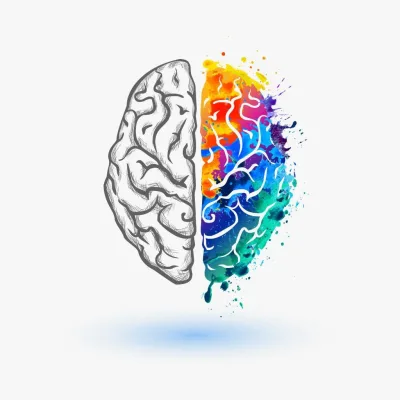
Neuro-aesthetics is the interdisciplinary field that looks at how your brain perceives beauty, art, and design. Think of it as neuroscience, psychology, and architecture having a brilliant baby. It decodes the “Symphony of Neural Activity” that occurs when your environment resonates with you.
The Aesthetic Toolbox:
- Colours with Vibe: How blues calm, greens inspire, and yellows energise (or reds make you hungry for a coffee break). But it’s not just about picking your favourite hue; it’s about understanding the subtle ways colours affect our physiology.
- Shapes & Feels: Why curvy lines are chill, and sharp angles make you a bit on edge. Do these preferences have an evolutionary basis? Perhaps our brains are wired to respond to forms that mimic nature.
- Nature’s Superpower (Biophilia): Our primal need for plants, light, and natural textures to de-stress and boost brainpower. It’s a longing for connection, a recognition of the interconnectedness of all things.
- Beyond Just Looks: Sound, touch, and even scent play a role in your brain’s aesthetic experience. These subtle cues can have a profound impact on our overall well-being.
III. A Walk Down Memory Lane: From Factory Floor to Drudgery
The “Efficiency First” Era (Early 1900s):
Think rigid rows, maximum bodies, minimal joy. Offices designed like factories, ignoring human psychology entirely. “Taylorism” reigned supreme. The human element was secondary, a mere cog in the machine.
The Dawn of Psychology (Mid-20th Century):
- Environmental Psychology starts asking: “Hey, does where we work *matter*?” A radical question at the time, challenging the status quo and prompting a re-evaluation of workplace design.
- “Office Landscape” (Burolandschaft) tries to break the mold with more organic layouts – but hello, open-plan distractions! An ambitious attempt, but perhaps too far ahead of its time, failing to fully account for the complexities of human interaction.
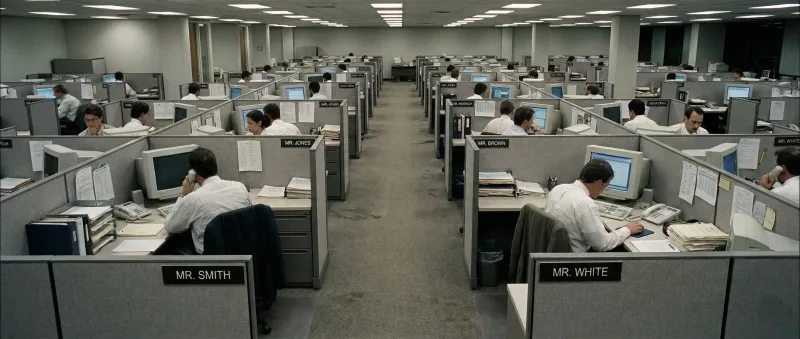
- The Cubicle’s Origin Story: Herman Miller’s “Action Office” aimed for personalization and privacy, not just cramming. A noble intention, perverted over time into the very symbol of corporate drudgery.
The Cubicle Backlash & The Wellness Awakening (Late 20th Century):
Cubicles often became cages. Widespread dissatisfaction proved that environment *does* impact productivity and well-being. Hello, Herzberg’s “hygiene factors”! A painful lesson, highlighting the importance of attending to basic human needs in the workplace.
IV. The Drab Office Death Trap: Why Beige is the Enemy
Mood Killers:
- The Morale Drain: Uninspiring spaces lead to disengagement, low job satisfaction, and a general feeling of “meh.” This sense of apathy can permeate every aspect of your work, stifling creativity and dampening enthusiasm.
- Stress City: Inadequate lighting, uncomfortable chairs, cramped spaces, and constant noise are literal headaches for your brain. These seemingly minor irritations can accumulate, leading to chronic stress and burnout.
Creativity Crunches & Focus Failures:
- Boring environments stifle innovation and make you feel sluggish. How can one expect to generate novel ideas when surrounded by visual monotony?
- Distractions flourish when spaces aren’t designed for concentration, making it impossible to hit those Q1 targets. Open-plan offices, in particular, can be a breeding ground for distractions, hindering deep work and focused thinking.
The Ambition Annihilator:
When your brain is fighting its environment, it’s not geared for goal-setting, problem-solving, or taking on new challenges. Seventy-five percent of employees agree: a bad office kills productivity. A stark statistic, underscoring the profound impact of the workplace on our cognitive abilities.
The Flip Side: A strategically designed office (even with small tweaks!) can dramatically boost morale, focus, and that elusive ambition. A glimmer of hope, suggesting that even modest improvements can yield significant results.
The Workways Difference: This is exactly why we designed our Brussels, Paris, and Dublin sites to move away from the “Beige Standard.” By utilising premium textures, natural light, and bespoke acoustic management, we create spaces that don’t just host your team—they energise them.
V. But Wait, There’s Controversy! (Because Science Isn’t Always Pretty)
Critics argue that “Beauty is in the eye of the beholder.” However, neuro-aesthetics suggests that while taste is subjective, biological responses to light, air, and space are universal. We aren’t just designing for “looks”; we are designing for the human nervous system.
Is Beauty Universal? (The “It’s Subjective!” Debate):
Can science really define universal beauty, or is it just personal preference? Neuro-aesthetics aims to understand *why* certain things resonate, not prescribe one-size-fits-all. The quest to identify underlying principles, while acknowledging the diversity of individual tastes.
The “Too Scientific?” Trap:
Critics worry about reducing rich aesthetic experiences to just brain states. Plus, translating complex brain science into practical office design is tricky! The challenge of bridging the gap between abstract scientific findings and concrete design applications.
Ethical Puzzles:
Designing for *all* brains means considering neurodiversity, sensory sensitivities, and ensuring privacy in data-driven spaces. A call for inclusivity, ensuring that the benefits of neuro-aesthetic design are accessible to everyone.
VI. The Future Is Bright (and Smart, and Green!): Your Office, Rebooted
AI & XR: Your Personalised Brain Spa Office:
- Smart Spaces: AI analysing behaviour for optimised layouts and personalised lighting/temperature. An intriguing prospect, raising questions about data privacy and the potential for algorithmic bias.
- Virtual Vibes: VR/AR creating immersive experiences for collaboration or even therapeutic stress reduction. A blurring of the lines between physical and virtual reality, offering new possibilities for enhancing the work experience.
- Neurofeedback Fun: Imagine your office adjusting in real-time to your brain’s needs! A futuristic vision, pushing the boundaries of personalization and adaptability.
Beyond Walls: Health, Healing, and Happier Humans:
- Offices as wellness hubs: designed for emotional regulation, cognitive function, and even rehabilitation. A holistic approach, recognising the interconnectedness of mind, body, and environment.
- Deeper dives into nature’s profound impact on health. Embracing biophilic design principles to foster a sense of connection with the natural world.
The Ethical & Inclusive Office of Tomorrow:
Future design will prioritise inclusivity for neurodivergent individuals, focusing on optimal sensory environments and personal control. A commitment to creating equitable and accessible workplaces for all.
The Grand Vision:
Creating spaces that enhance creativity, empathy, and resilience – making us more human in an AI-driven world. A lofty goal, striving to harness the power of design to foster human flourishing.
At Workways.com, we aren’t waiting for the “Future.” Our Managed Office model already incorporates these principles. We handle the “Invisible Infrastructure”—from enterprise-grade security to biophilic design—so your team can move from “Sluggish” to “Sovereign” the moment they walk through the door.
Your browser does not support the video tag.
VII. So, What is Your Office Saying to Your Brain?
The Takeaway:
Your workspace isn’t just a place you go; it’s a powerful force shaping your performance and well-being. A call to action, urging us to recognise the profound impact of our surroundings.
Small Changes, Big Impact:
Even simple additions like plants, better lighting, or a splash of calming colour can make a huge difference. A reminder that even small interventions can have a ripple effect, transforming the work environment for the better.
Don’t let drab kill your 2026 ambition.
Ready to see a better way of working? Book your private tour of a Workways Managed Office today.
Workways provides high-spec, bespoke managed offices across Dublin, Paris, and Brussels. Discover how we can transform your team’s productivity for 2026.