
 Fr
Fr
I. The “Quick Question” That Costs You Half an Hour
We’ve all been there.
You’re deep in the weeds of a complex spreadsheet or finally finding the right words for a strategic proposal. You’ve hit that rare, elusive state of flow.
Then comes the dreaded tap on the shoulder.
“Sorry, have you got a quick second?”
And of course, you answer the question. It takes maybe a minute. You turn back to your screen—but the magic is gone. The mental scaffolding you built has collapsed.
Research from Gloria Mark at the University of California, Irvine, suggests it takes an average of 23 minutes and 15 seconds to get back to your original task with the same level of concentration after an interruption.
However, in a typical open-plan office, this doesn’t just happen once. It happens four, five, maybe ten times a day. That isn’t just a minor annoyance; it’s a Productivity Tax that your business—and your mental health—simply can’t afford to keep paying.
II. The Audit: Calculating Your “Focus Leak”
Let’s be honest about the maths for a moment.
Step 1 – The Interruptions
Think about your average Tuesday. How many times are you pulled away by:
- General office chatter or background noise
- “Quick questions” that are never actually quick
- People walking past your line of sight
- Slack pings that inevitably spiral into full-blown debates
Step 2 – The Multiplier
Take that number and multiply it by 23 minutes.
Step 3 – The Reality Check
Therefore, were you interrupted just four times today, you’ve effectively lost over 90 minutes of your best cognitive performance.
For example, a team of 20, that makes 30 hours of high-level work vanishing into thin air every single day. This isn’t a “soft” cultural issue or a bit of office friction. It’s a hard business cost that shows up directly on the bottom line.
III. The 2026 Shift: From “Collaboration” to “Concentration”
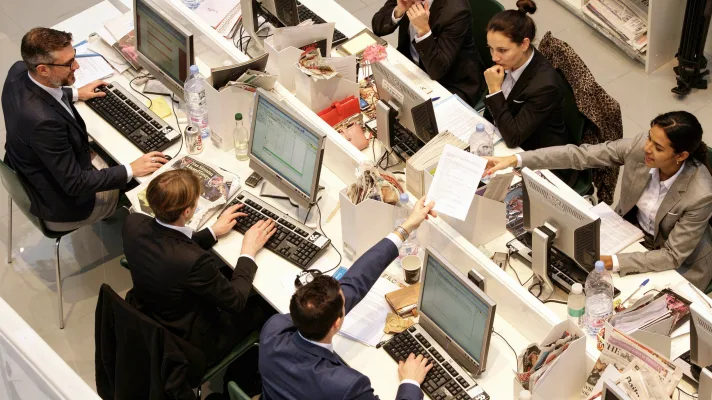
For the best part of a decade, office design has been obsessed with “collisions”—the theory that if we all just keep bumping into each other at the coffee machine, innovation will happen by magic.
But as we head into 2026, the data is telling a different story: collaboration without the ability to concentrate is just noise.
As a result, the trend for the coming year is the Bespoke Managed Suite. Forward-thinking companies are moving away from the “sea of desks” and towards environments that actually respect how the brain works:
- Acoustic Sovereignty: Proper sound-treated walls and doors. Conversations should stay in the room they started in, not in everyone else’s head.
- Visual Privacy: Eliminating the “peripheral flinch”—that constant, subconscious distraction of people moving in your eye line.
- Zoned Workspaces: Intentional areas for high-energy brainstorming, library-style zones for deep work, and proper quiet rooms for confidential calls.
The office of the future isn’t “cooler” or louder. It’s calmer and more intentional.
IV. Why Home Isn’t Always the Answer
It’s tempting for managers to think the solution is simple: “Stay at home for focus, come to the office for the social stuff.”
But the latest research shows that the “Third Place” has its own version of the Focus Tax. Between the doorbell, the laundry staring at you from the corner, a loved one asking a question, and the psychological blur of living and working in the same four walls. Therefore, home isn’t always the sanctuary we imagine.
So we now know, the most productive teams in 2026 aren’t working from kitchen tables or bustling coffee shops. They’re using high-spec, managed environments that are purpose-built for professional output. They need clear boundaries, reliable infrastructure, and a space that supports both the “we” and the “me.”
V. The Sovereign Surplus: Flow as a Wellbeing Strategy
There’s a secret that high-performers rarely talk about: The faster you get into Flow, the sooner you get to switch off.
When you stop paying the “23-Minute Tax,” you aren’t just doing more work for the company. You’re reclaiming your own time.
When you save 90 minutes a day by working in a high-focus environment, that’s 90 minutes you don’t have to “make up” at 8 PM. Deep work is exhausting, and it requires proper recovery. Therefore, by protecting your focus during the day, you’re actually protecting your evening.
After all, what’s the point of being a leader when you’re too burnt out to enjoy the life you’ve built?
VI. The Workways Difference: Engineering the Flow State
At Workways.com, we don’t just rent out desks. We provide sovereignty over your attention.
As a result, when we designed our suites in Brussels, Dublin, and Paris, we didn’t look at what was trendy; we looked at what was effective:
- Enhanced Soundproofing: Because a private office should actually be private.
- Smart Zonation: Ensuring your team (whether you’re 10 or 50 people) has dedicated zones for deep work and collaboration, all within your own private suite.
- Zero-Friction Management: We handle the IT, the coffee, the cleaning, and the security.
Your brain has one job: the work that actually moves the needle. We handle the rest.
VII. Join the Conversation
Is the open-plan office a relic of the past, or do you genuinely thrive in the buzz? We’re looking to talk to leaders who are ready to rethink what a productive workspace actually looks like.
👉 Take our 2-minute Workplace Productivity Audit
See how your current office scores against 2026 standards for privacy, zonation, and your personal “Focus Tax.”
Workways provides managed office suites designed for teams that take their time seriously. Stop paying the Focus Tax. Experience a better way of working in Dublin, Paris, and Brussels.