
 Fr
Fr
By Workways Strategy
Dublin | Brussels | Paris – Reading Time: Approximately 5 minutes
It usually begins long before you’ve even reached your desk.
It starts with that heavy, rhythmic thud of a car door closing against a grey, horizontal Dublin rain. It’s there in the damp, woolly scent of a packed Brussels Metro carriage, and in the way the taillights on the Périphérique blur into a smear of tired red against the morning mist.
By the time you step into the lobby, your coat feels heavier than usual. You shake off the rain, but you can’t quite shake the weight of the week. You’re seeking a bit of warmth, but what you walk into is the “Light of the Lab”—that sterile, shadowless fluorescent glare that has come to define the modern workplace.
As you hang up your coat and prepare to “start,” a second storm begins. This one isn’t made of wind and rain, but of exposure.
 The Unseen Tax of Performance
There is a specific kind of Friday exhaustion that has almost nothing to do with your actual to-do list. It’s an exhaustion of the spirit, born from a week spent under the silent, nagging pressure of “social surveillance.”
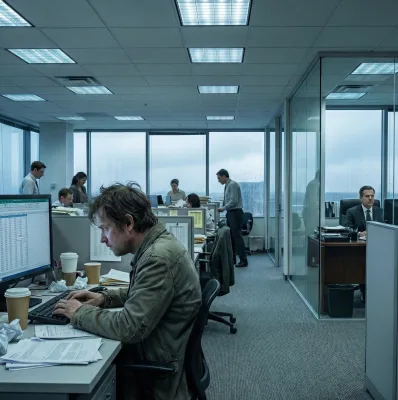
In a traditional open-plan office, you aren’t just working; you are performing work.
From the moment you sit down, you’re on a stage. You’re aware of the line of sight from the glass-walled executive office; you’re conscious of the colleague two desks over who can hear every word of a sensitive client call. You feel that unspoken mandate to look accessible, to look busy, and to look “collaborative.”
This is the Mantle of Performance. For the employee, it’s a drain on energy. For the business leader, it’s a hidden drain on capital. It is the cognitive tax we pay to maintain a professional facade while simultaneously trying to solve complex problems. We aren’t just managing our spreadsheets; we’re managing our optics. We are “on,” even when we desperately need to be “in.”
The Paradox of Proximity
We were told that removing walls would spark innovation. We were promised that “collisions” at the coffee machine would lead to the next great breakthrough. But the reality has been somewhat more sombre.
has highlighted what’s known as the Open Office Paradox. The data revealed that when companies moved to open-plan layouts, face-to-face interaction didn’t actually increase—it plummeted by nearly 70%.
As humans, we are biologically wired to seek sanctuary when we feel exposed. When we lose our physical walls, we simply build digital ones instead. We put on our “headphones of solitude,” avoid eye contact, and retreat into our screens. We create invisible silos just to protect a tiny corner of our own attention.
For the decision-maker, this is the ultimate irony: you are paying a premium for “collaborative” square footage that is actually driving your best talent into silence.
The Sovereignty of the Door
We’ve all had that moment, especially on a day like today, where we look at a closed door with a sense of pure envy.
It isn’t because we’re anti-social. It’s because deep, high-leverage thinking is, by its nature, a private act. It requires a “Right to Retreat”—the ability to step out of the wind and into a space where your energy belongs solely to you.
The “Friday Funk” many of us feel by lunchtime isn’t usually caused by a lack of ambition; it’s caused by environmental friction. When you can’t control the temperature, the acoustics, or the visual chaos of your surroundings, your brain enters a state of perpetual “alert.” You end the day feeling drained, not by the difficulty of your tasks, but by the sheer effort required to ignore the world around you. For the executive paying the rent, this friction is the “silent killer” of Q1 momentum.
Engineering the Sanctuary
At Workways, we don’t believe in “Beige Boxes” or the “Productivity Theatre” of the traditional lease. Our tagline—Flexible by Nature—is a commitment to both the human nervous system and the corporate balance sheet.
We believe that for a team to be truly “sovereign,” they must have the power to disappear when they need to.
Our Office Suites are engineered for the relief that comes with the “Turn of the Key.” They are designed with the understanding that a heavy acoustic door is perhaps the most powerful productivity tool in the world. When that door closes, the Mantle of Performance falls away. The social surveillance stops. In a Workways suite, you don’t have to look like you’re working. You can just work.
Sovereignty in the Interim: Tips from the Workways Strategy Team
Until you find your way behind a Workways door, our Strategy Team has identified four “Sovereign Sprints” you can use to protect your energy and focus today:
- Sensory Sovereignty: Think of high-quality noise-cancelling headphones as a “visual wall.” In a bustling office, the headphone is the universal signal for “do not disturb.” Respect that signal in others, and don’t be afraid to demand it for yourself.
- The “Deep Work” Block: Carve out a 90-minute window on your public calendar and mark it as “Unavailable.” Treat this time as a sacred appointment with your own concentration—one that cannot be moved or interrupted.
- Digital Boundaries: Close your email tab and put your phone in a drawer. If you can’t control the physical noise of the room, at least eliminate the digital noise of the screen.
- A Change of Scenery: When the “Mantle of Performance” feels too heavy, move. Find a quiet corner, a library, or even a local café—anywhere where you aren’t “on display” and can simply get on with the task at hand.
A Friday Diagnostic
Whether you are the one hunched over a laptop feeling the hum of the office in your ears, or the leader looking at a P&L and wondering why momentum has stalled despite the “open” floor plan—it doesn’t have to be this way.
If you are paying the rent, you are paying for this friction. If you are doing the work, you are paying with your energy. This exhaustion is valid, and it isn’t “just the weather.” It is the result of an environment that is taxing your collective potential.
We’ve built a diagnostic tool to help our community—from founders to freelancers—put a hard number on this feeling. It’s a way to validate the human experience and the financial reality, showing exactly how much cognitive bandwidth and capital is being lost to the status quo.
[Take the 120-second Productivity Audit]
See your score, reclaim your narrative, and discover what a “Focus-First” environment looks like for 2026. Because by the time the rain stops this evening, you shouldn’t just be finished with your work—you should be ready for your life.
And if you’re ready to stop building invisible walls and start working behind real ones, we should probably have a chat. 😉